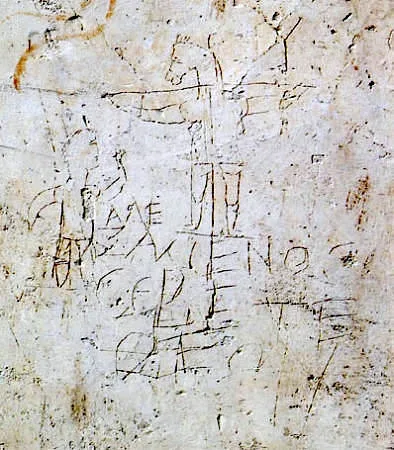
Above is "Alexamenos graffito", now in Palatine museum in Rome, which is been removed from a wall near the Palatine hill in Rome. This graffiti is said to be of AD 200 or so. On keen observation you can find a donkey or a mule on a cross, and below are scraped Greek letters which read, Ἀλεξάμενος σέβεται θεόν (Alexámenos sévetai theón) which means, "Alexamenos worships (his) God". We can see a young man, probably a guard named Alexamenos, a christian who can be seen raising one hand as a symbol of adoration towards his God.
Emperor Septimius Severus (AD 193 - 211) was reigning in Rome. As a remedy to avoid rebellion and civil war in the country, he opted for religious tolerance, which seems to be a right move by an emperor. But with one clause, that in the pantheon of gods the "unconquered Sun god" is to be accepted above all other gods or the Sun god is to given priority above his/her own faith. This wasn't acceptable to the Jews and the Christians. Although there was religious tolerance in the time of Septimius Severus, Christian history does not forget the execution of five people in AD 203, at Carthage, Africa, at the military games on the eve of emperors birthday. Perpetua, Felicity and Saturus were among the five martyrs on that day. On the other hand due to the persecution by the past emperors there was mockery upon Christians, teasing that the God they believe in was crucified on the cross. For Greeks, one who has not sufficient wisdom to save himself from shameful and horrible death was a sheer folly. To the Romans, they see their gods as all powerful and cannot accept Jesus as God who died a death on the Cross helplessly.
Donkeys were represented in a negative form by the Greeks, where they were generally portrayed as stupid and stubborn, or of a characteristic of slave and generally represented as lower class. They were often contrasted with horses, which were seen as powerful and beautiful. In Aesop's literature "The Ass in the Lion's Skin", he protray donkey as a fool. In Apuleius's "The Golden Ass" he portray donkey as stubborn, foolish, wicked and lowly. The famous Shakespeare popularised the use of the word "ass" as an insult meaning stupid or clownish in many of his plays. This insult continued in the times of the Romans too.
On the flip side, we generally see that breeds like Akita, Appenzeller Sennenhund, Australian Shepherd, Bullmastiff, Catahoula Leopard Dog, Caucasian Shepherd Dog etc., as some of the best watch dogs or guard dogs. Herdsmen generally use these beeds to keep their domestic animals safe. Some of these breeds are so costly to buy. So few herdsmen who can't afford to buy the costly breeds, use donkeys as an alternative source. Donkeys are very affordable at price. Donkeys are a great option for guarding grazing animals like goats or sheep, because they have very similar care requirements. Donkeys are the silent guard animals, and will notify intruders. They will fiercely protect the herd themselves, using kicks and strikes with their hooves and bites with their large teeth. Not only are these territorial animals excellent for guarding, but they can also be useful in more ways for transportation, weighing loads, etc.,
Jesus says, "..often I have wanted to gather your children together as a hen protects her chicks beneath her wings.." (Matt 23:37, NLT). As prophet Isaiah says, God is hovering over us like a guard, He will shield and rescue us from the adversary (Isaiah 31:5). As "your adversary the devil, as a roaring lion, walketh about, seeking whom he may devour" (1Peter 5:8, ASV). As Jesus shows his confidence in His sheep and says, "My sheep hear my voice, and I know them, and they follow me: And I give unto them eternal life; and they shall never perish, neither shall any man pluck them out of my hand, I am the good shepherd; I know my sheep and my sheep know me." And to the lost sheep He says, "I have other sheep that are not of this sheep pen. I must bring them also. They too will listen to my voice, and there shall be one flock and One Shepherd." This Shepherd is ready to lay down His life self willingly for the sake of guarding His (lost) sheep. (John 10:14-18, NIV).
Are we ready to accept the mockery as Alexamenos who was quiet when his faith was been teased and ridiculed? Are we the lost sheep or the sheep of His pen?
Now that you were given the required dots, try to connect the dots accordingly and draw parallels to see the bigger picture.